
School of Taste
"I drink a second mouthful, in which I find nothing more than in the first, then a third, which gives me rather less than the second. It is time to stop; the potion is losing its magic. It is plain that the truth I am seeking lies not in the cup but in myself". Swann's Way, Marcel Proust
Flavour MATTERS
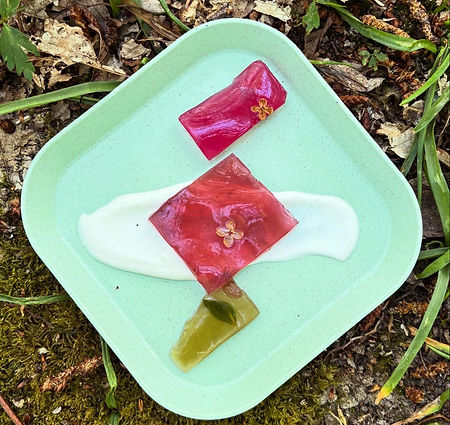
This programme dives deep into wild & cultivated tastes, immersive woodland connection and sensory meditation. While reimagining our relationship to plants, these taste and smell experiences not only challenge us to reconsider what and how we eat but also how the act of eating can become a meditative practice. This will be an exploration of the aromatic characteristics of local flora and the sounds and gestures of ancient narratives. As a group, we smell, forage, and savour a variety of plant and fungal flavours, all in a quest to reconnect with nature's rich offerings and their deeper meaning.
Moreover, as every edible form conveys information from one living being to another, sharing the vital knowledge that nourishes our existence, we will together explore ways of creating language, colours, shapes that give voice to the flavourscapes we experience.
Just like our family flavour programme, our collaborative practice will inform our growing archive into a shared FlavourBank. The FlavourBank is a physical archive to capture our flavourscapes in an age of the fleeting biodiversity. Within this, we are actively investigating and reimagining new ways to document and store flavours all in an attempt to keep what is and preserve what we are gifted to our future generations.
This event series includes a woodland walk, a sense mediation, an inspiring talk addressing themes around biodiversity and more than human ecology followed by an abundant taste workshop.



Family Flavours
family & youth programmes
In childhood, the flavours we encounter are intricately woven by the threads of family and environment. Within the heart of every home lies a culinary tradition. Each meal prepared carries stories and memories, offering a gateway into the diverse world of flavours. This does not mean that we all should aim to grow up in a a home version of Michelin starred kitchens, instead it is important to honour our roots, which more than often means to honour our mothers, our grandmothers and their edible care. Yet beyond the kitchen, young and old are now exposed to the brightly packaged snacks, sugary cereals, and fast-food feasts, captivating young minds. The allure of these products can be overwhelming, creating cravings that often drown out the voices of parents and caregivers, or even our own bodies. The constant noise of advertising not only limits children’s exposure to diverse, nutritious options but also erodes the continuation of many family’s cultural heritage or culinary traditions when shaping children's narrowing dietary habits - like the known phenomenon from multicoloured to beige.
As we embark on our Family Flavours youth project, we invite young minds AND bodies to explore how these early taste experiences shape our culinary identities.This distinctive series of culinary workshops offers an opportunity to truly immerse the whole family in the sense of taste. These hands-on and engaging sessions connect children to food, their natural surroundings, and one another without pressure or dogma. Our aim is to deepen their relationship with food, enhance their palette skills, and inspire them to become positive agents of change within their lives and communities. Together, we will explore flavour profiles, understand how our preferences are shaped, and gain insights into the formation of our food choices. In the older youth courses, we will also explore concepts of food sovereignty and look more closely where our food comes from.
All flavour research that results through these workshops will anonymously be recorded to enrich our living archive or flavours. As part of our FlavourBank, we are hoping to record children's authentic perspective and voices about food and our edible landscape in a time of food insecurity and shrinking biodiversity. Together with the children we will try and imagine new ways of more fair and evenly distributed food systems for humans and more-than-humans!